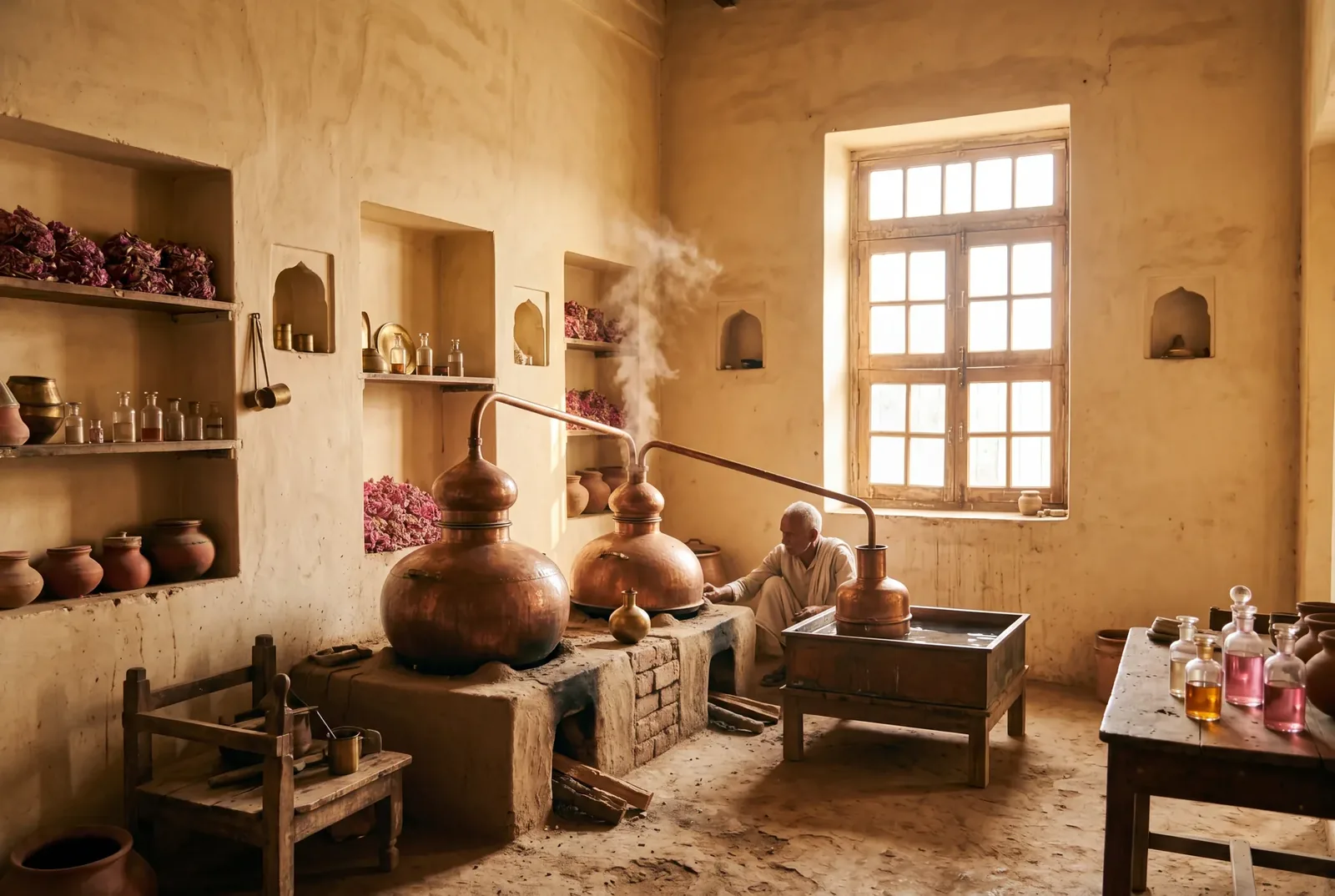
A town on the Ganges plain has been distilling scent from the ground itself for six hundred years. One of the things it makes has no equivalent anywhere: an attar of baked earth that smells of the first rain. A.001 is built on it.
Kannauj has run an unbroken tradition of steam distillation since the sixteenth century, supplying the courts of Awadh and, later, much of the attar of the subcontinent. Roughly four hundred distilleries still work there. The season runs on what is in flower, so the same still produces rose in April and mitti in June.
The deg and the bhapka
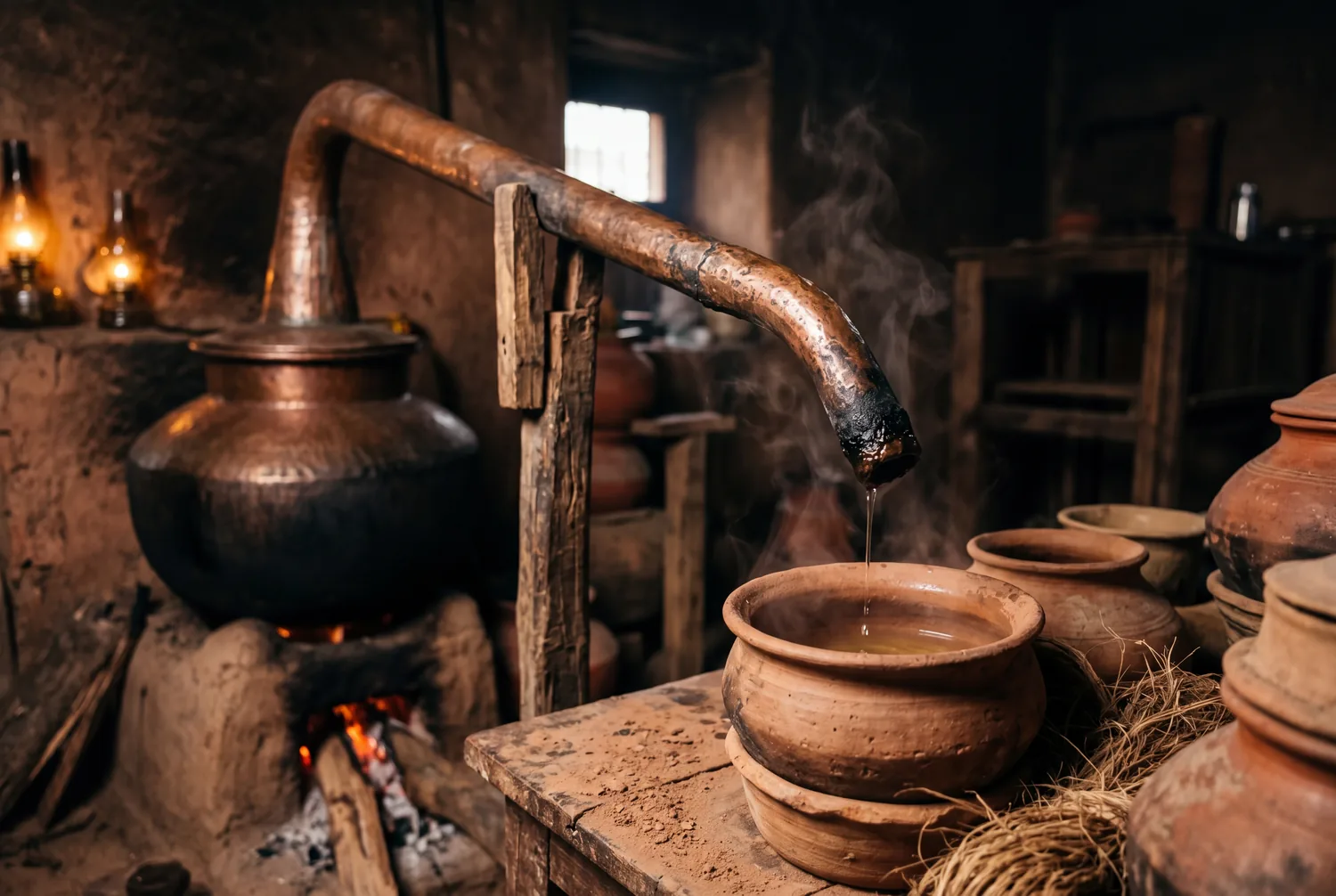
The method has barely changed. Botanicals — rose, jasmine, vetiver, the wood of the night — are loaded into a copper still, the deg, sealed with cotton and clay, and set over a wood fire. The vapour travels through a bamboo pipe into a receiver, the bhapka, that sits submerged in cool water and already holds a base of sandalwood oil. There is no thermometer. The distiller reads the still by the sound of the boil and the weight of the receiver in the hand, swapping vessels by instinct across a twelve-hour day. It is among the most demanding crafts in all of perfumery, and it is done almost entirely without instruments.
The most Indian smell in existence is not a flower. It is the ground, the moment before the rain.
Mitti — the scent the world has no word for
Of everything Kannauj produces, one material has no equivalent anywhere on earth. To make mitti attar, distillers take baked discs of the local clay — earth, literally — and run the steam through them. What condenses is petrichor: the precise smell of the first monsoon rain striking hot, dry ground. It is bottled into sandalwood and sold by the tola. Western perfumery has the chemistry to gesture at it — geosmin, a molecule the human nose detects at five parts per trillion — but it has no tradition of capturing it. Kannauj has done so for centuries, and barely anyone outside India knows.
The chemistry is known. Geosmin, the molecule behind the smell of wet earth, is detectable by the human nose at about five parts per trillion and can be synthesised. What cannot be synthesised is the rest of the distillate — the clay, the fire, the sandalwood base it lands in. That is the part we buy.
What we do with it
A.001 Before the Rain is built around the mitti rather than decorated with it: green cardamom and cool aldehydes above, the wet mineral earth and ruh khus from Hathras at the heart, a clean musk beneath. Macerated six weeks. Eight to ten hours on skin, longer on cotton, and quiet the whole way through.
The distillers have been doing this since before the word perfume reached a French invoice. Our part is small: buy the good grade, say where it came from, and wait long enough before bottling it.